
RPM Webinar Highlights Mental Health Issues of Migrant Workers: From Trauma to Art as Therapy
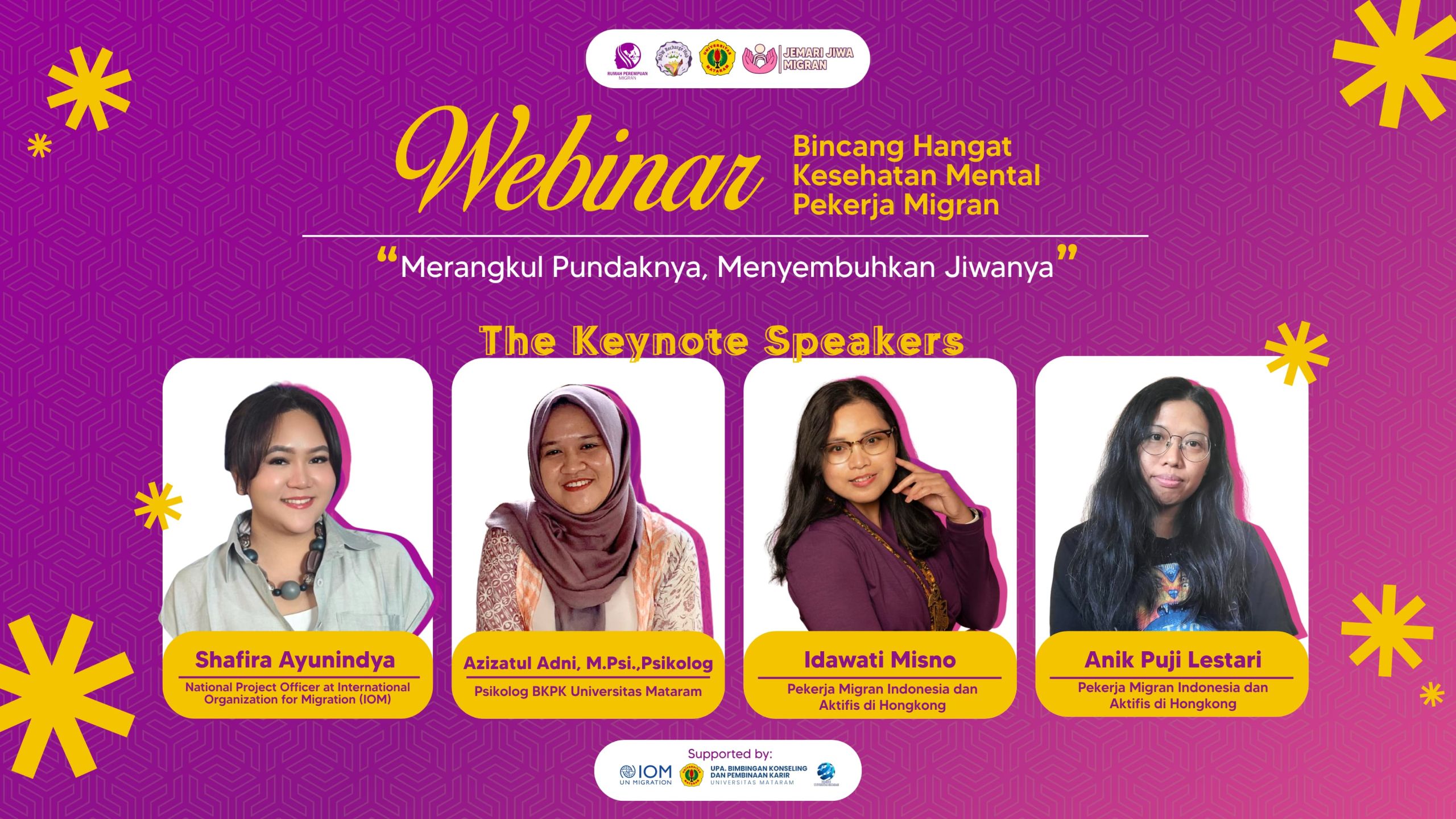
Mataram, University of Mataram – The Jemari Jiwa Migran (Jwara) Project, part of Rumah Perempuan Migran (RPM), held a webinar titled “Warm Talks on Migrant Workers’ Mental Health.” The webinar invited various Indonesian migrant communities in West Nusa Tenggara (NTB), including Pancakarsa, Migrant Care, Indonesian Migrant Workers Advocacy, Senyumpuan, NTB Smart Volunteers, Indonesian Migrant Workers Association, Beriuk Bareng Peduli, Ecco Foundation, Japanese Migrant Community, BP3MI NTB, Diskominfotik NTB, BKPK Unram, LPPM Unram, Indonesian Migrant Workers Union, Legal Aid Institute of the Indonesian Women’s Association for Justice NTB, FKMHII Regional Branch 6, and HMHI Unram.
The webinar took place on Sunday, June 1, 2025, with the aim of equipping and informing Indonesian migrant workers about the importance of mental health, as well as raising awareness of the signs and symptoms of mental health issues.
The first speaker, Shafira Ayunindya, emphasized that mental health is one of the key factors in the success and well-being of migrant workers. She stressed the importance of accessible psychosocial support programs for Indonesian migrant workers, so they can receive help promptly when needed.
“Due to the many challenges that arise during the migration process, mental health issues often emerge such as psychosomatic symptoms, feelings of anger and sadness, depression, anxiety, substance and alcohol abuse, poor sleep quality, and lack of concentration at work. To address these issues, the IOM has launched several initiatives, including partnerships with Yayasan Pulih, improving migrant workers’ access to psychosocial support services, and organizing activities with migrant workers,” she explained.
In addition, psychologist Azizatul Adni from BKPK Unram explained that mental health issues are a vulnerable area for every individual, including migrant workers. She pointed out that even small things like a lunch that doesn’t meet expectationsca n impact a person’s mental state.
“Depression and anxiety are two of the most common mental health conditions experienced by migrant workers. Depression may manifest as episodes of deep sadness over certain days or periods of time. Withdrawing from social environments and losing the motivation to carry out daily activities are common signs of depression,” Adni explained.
Adni also noted that migrant workers are vulnerable to discrimination, homesickness, and the pressures of heavy workloads, making them highly at risk for mental health disorders. Therefore, it is crucial for migrant workers not to keep their problems to themselves, but instead to actively communicate and interact with others, as this can greatly help in maintaining and recovering their mental well-being.
Following that, Idawati Misno, co-founder of Woman’s Journal and a former migrant worker in China, shared her personal experiences while working in the country. Miss Ida spoke about the mental challenges she faced during her time abroad, and how interaction and communication among fellow workers particularly through migrant worker communities in China played an important role in offering mutual support and preventing feelings of isolation.
“Art plays an important role in mental health, especially for migrant workers. After I transformed Women’s Journal into a platform for art and creativity, particularly in Hong Kong, many Indonesian migrant workers began using art as a means of emotional expression,” she said.
Miss Ida shared her experiences as an Indonesian migrant worker (PMI) in Hong Kong and how creative activities like painting became a way for her to calm herself and experience joy.
The final session was delivered by Anik Puji Lestari, an activist and former Indonesian migrant worker in China. In her presentation, Miss Anik explained that trauma experienced during childhood can have a profound impact on one’s adult life. These effects are often amplified when working abroad amid separation from family, high work pressure, and a lack of adequate rest.
Even so, Miss Anik emphasized that with the support of those around us whether from communities or professional help mental health issues can be addressed and managed.
“As a migrant worker, I once struggled with low self-esteem caused by childhood trauma and was afraid to open up to others. However, after joining various activities and training programs from communities like Sunflower, MDW Recharge Hub, and other Indonesian migrant communities in Hong Kong, I gradually regained my confidence and learned many things that can truly help save us,” she shared.
The webinar then continued with a discussion and sharing session, where many current and former Indonesian migrant workers shared their personal stories of living and working abroad. This webinar served as a crucial platform to raise awareness especially among migrant workers and their families that mental health is an essential issue and not a sign of weakness.