
ICST 2025 Focuses on Science and Technology Innovation for the Development of Archipelagic Regions
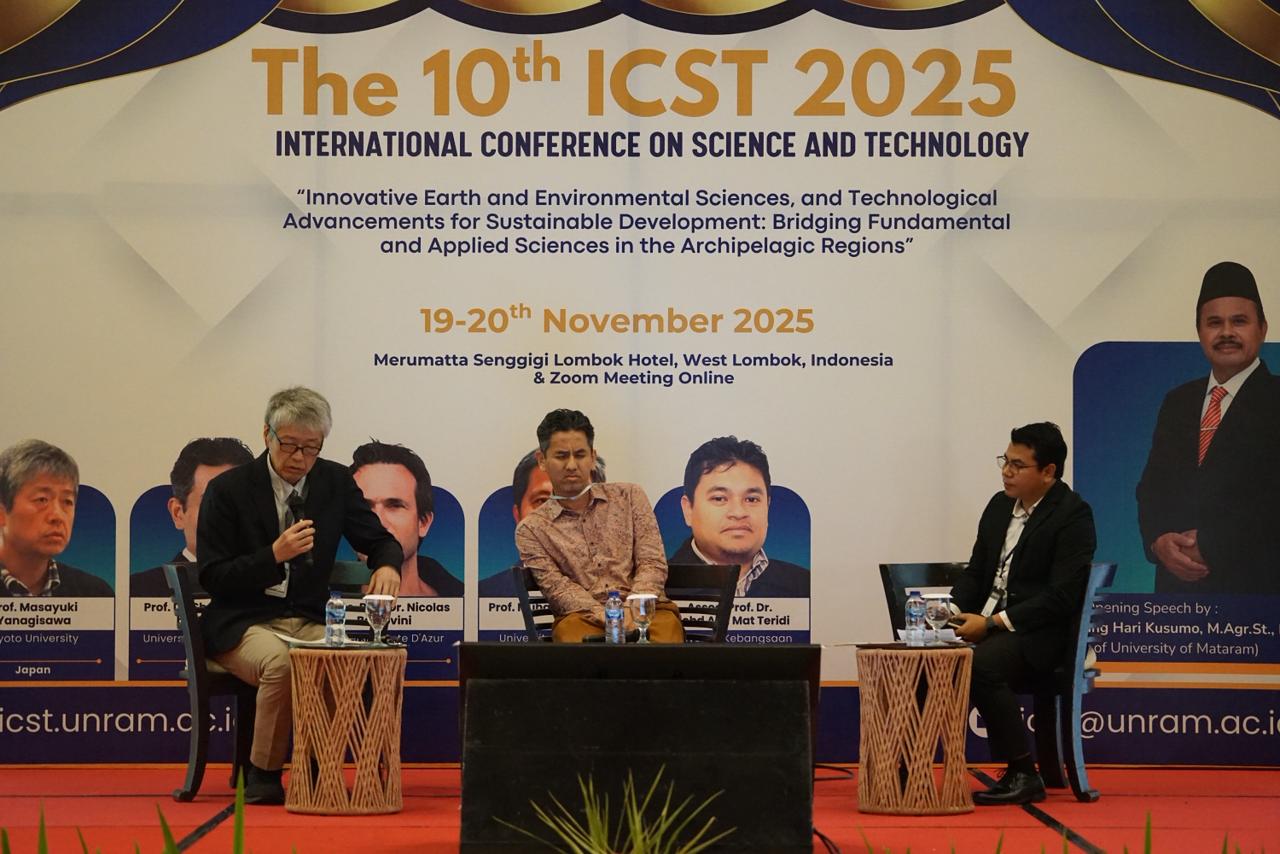
Mataram, University of Mataram – The 2025 International Conference on Science and Technology (ICST) was held again by the University of Mataram’s Institute for Research and Community Service (LPPM Unram) as a form of academic contribution to global issues, particularly those related to the development of archipelagic regions. This event was held on Wednesday, 19 November 2025, in a hybrid format at the Merumatta Hotel, Senggigi, and via Zoom Meeting.
The 10th ICST took the theme “Innovative Earth and Environment Sciences, and Technological Advancements for Sustainable Development: Bridging Fundamental and Applied Sciences in the Archipelagic Regions”. This theme was chosen to emphasise the urgency of applying science and technology in responding to development challenges in the Indonesian archipelago, particularly in the West Nusa Tenggara (NTB) region.
The Chair of the ICST 2025 Committee, Assoc. Prof. Mamika Ujianita Romdhini, Ph.D, explained that this theme is also in line with the direction of local government policy.
“Every year, we follow the developments in central, regional, and Unram policies. This year, the Governor emphasised the focus on archipelagic development, so we chose a theme that highlights how science and technology can be applied in the Indonesian archipelago. Therefore, we invited keynote and invited speakers from various relevant fields,” she said.
The keynote speakers at this international conference were:
-
Assoc. Prof. Dr. Nicolas Baldovini from University Cote D’Azur, France
-
Prof. Dr. Shaiful Jahari bin Hashim from Universiti Putra Malaysia, Malaysia
-
Prof. Masayuki Yanagisawa from Kyoto University, Japan
-
Prof. Muhamad Ali, Ph.D. from University of Mataram, Indonesia
-
Assoc. Prof. Dr. Mohd Asri Mat Teridi from Universiti Kebangsaan Malaysia, Malaysia
In addition, there are five invited speakers, consisting of:
-
Prof. Dra. Susilawati, M.Si., Ph.D. from University of Mataram, Indonesia
-
Prof. Dr. Dra. Tri Mulyaningsih, M.Si. from University of Mataram, Indonesia
-
Prof. Dr. Matheus Souisa, M.Si. from University of Pattimura, Indonesia
-
Assoc. Prof. Faisal Al-Sharqi, Ph.D. from University of Anbar, Iraq
-
Assoc. Prof. Dr. Iskandar Shahrim Mustafa from University Sains Malaysia, Malaysia
Prof. Mamika added that ICST 2025 was attended by 225 participants from 11 countries, with 191 presenters presenting their research results. This large participation shows the strengthening of cross-country research collaboration.
“One can imagine how much collaboration and new knowledge has been built from various parts of the world. We hope that these research results can strengthen policy makers, both at Unram, the provincial government, and the national government, especially for the advancement of the archipelagic region,” she said.
The Head of LPPM Unram, Dr. Andi Chairil Ichsan, S.Hut., M.Si., pointed out that this year’s ICST theme is not only academically relevant but also strategically important in responding to environmental, social, and regulatory issues.
“The urgency of this theme is on a global scale. We are talking about scientific-based technological development and environmental issues that are intertwined with social and policy issues. Environmental problems are the root of many issues, and through technology and global collaboration, we can offer impactful solutions,” he explained.
He also emphasised that ICST has different publication standards compared to ordinary national seminars. “Because the target is global, publications from this conference must be accessible and readable by various countries. Therefore, they must at least be indexed by Scopus, not just Sinta,” he said.
This year, ICST is targeting 60–80 articles from a total of 191 submitted articles to be published in reputable international journals. In addition to the conference sessions, the 10th ICST also held its first field trip to Gili Nanggu, Gili Tangkong, and Gili Kedis, which received enthusiastic responses from participants.
LPPM Unram also reported a significant increase in the number of citations of Unram lecturers’ articles, from around 4,000 citations in 2024 to 10,000 citations in 2025. This increase is cited as evidence that Unram’s research contributions are increasingly recognised globally.
The conference also opened up opportunities for research and community service collaboration between Unram and various overseas universities. International collaboration is expected to further strengthen Unram’s academic reputation and global engagement in the future.