
AFEBI XIII Congress in Lombok Advances Impactful and Sustainable Tourism Transformation
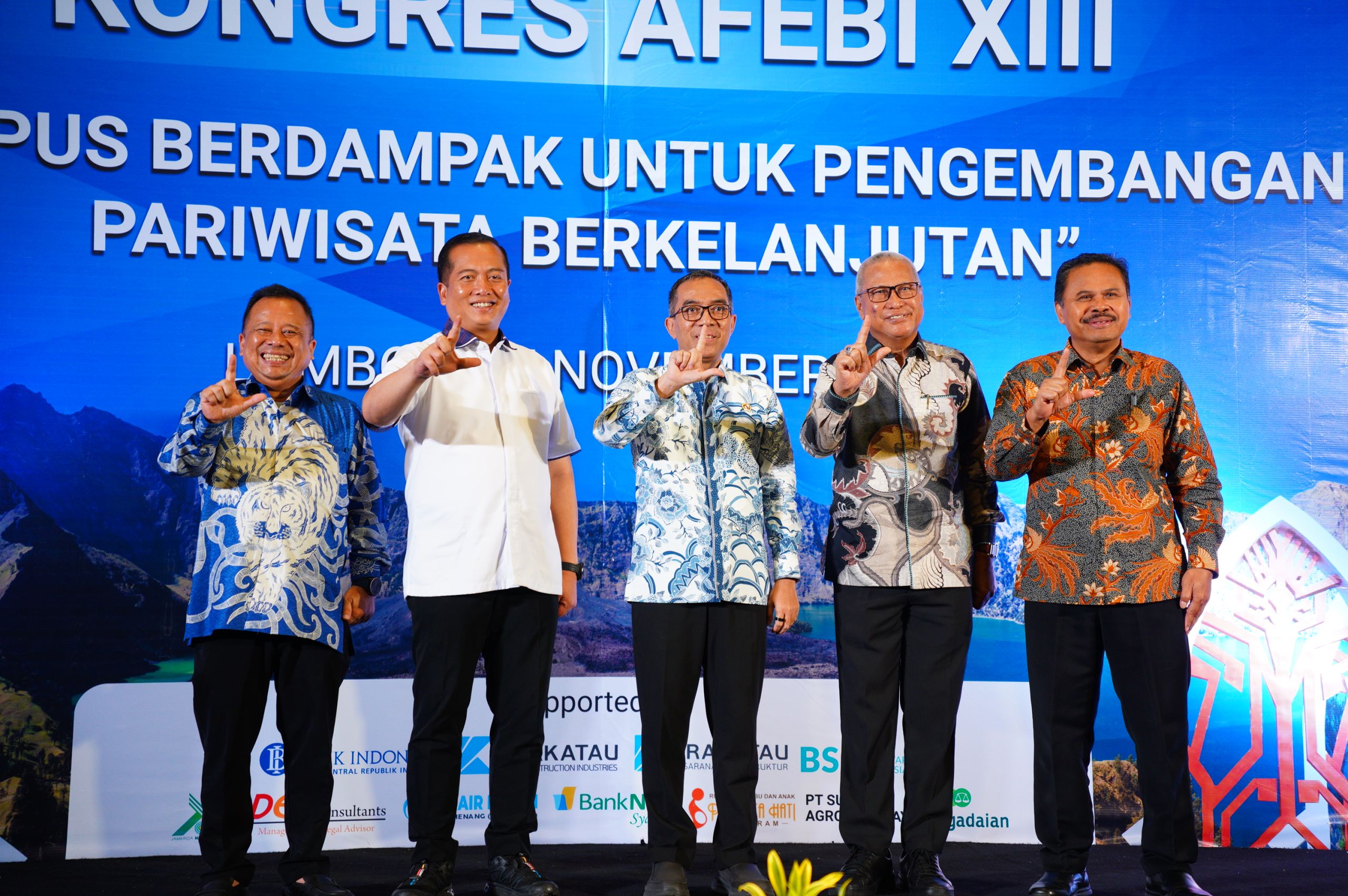
Mataram, University of Mataram — The national collaboration forum, the 13th AFEBI Congress, was successfully convened in Lombok on 26–28 November 2025. Carrying the theme “Impactful Universities for Sustainable Tourism Development,” the congress underscored the urgency of strengthening tourism development both regional and national through research-driven collaboration, innovation, and evidence-based policy recommendations.
The event, held at Aruna Senggigi Resort & Conventions, was attended by representatives from the Faculty of Economics and Business (FEB) from all over Indonesia who are members of the Indonesian Association of Economics and Business Faculties (AFEBI).
Rector of Universitas Mataram, Prof. Ir. Bambang Hari Kusumo, M.Agr.St., Ph.D., in his remarks expressed his appreciation for the trust placed in Lombok as the host of this year’s congress. “AFEBI plays a strategic role in driving economic and tourism development. We are honored to host this congress and hope that the presence of all participants will contribute meaningfully to both regional and national development,” he stated.
The Minister of Higher Education, Science, and Technology of the Republic of Indonesia, Prof. Brian Yuliarto, S.T., M.Eng., Ph.D., in his keynote session emphasized that the theme of the 13th AFEBI Congress is highly strategic and aligns with the ongoing transformation of higher education and regional development. “This is the era of collaboration. The impact we generate will be far greater when universities, government, and industry move together. This is the key for us to remain competitive alongside other nations,” he stated.
Prof. Brian emphasized that tourism transformation must continue to be guided by the principles of sustainability and broad societal benefit. He highlighted the need for bold steps in accelerating the strengthening of academic and industrial ecosystems. “We must be confident and foster collaboration across universities and all stakeholders. This sector must serve as a catalyst to propel Indonesia toward becoming a developed nation through world-class, comprehensive tourism services,” he explained.
He further noted that NTB holds a strategic position as a hub for sustainable tourism development, while faculties of economics and business play a pivotal role in bridging data, policy, and innovation. “FEB holds a critical function from mastering data and enabling evidence-based decision making, to designing business models and strengthening analytical and economic capabilities. With strong industry networks and analytical excellence, FEB can accelerate financial independence and deliver meaningful impact for regional and national development,” he stated.
He also underscored the vital role of FEB as an impact engine, revenue engine, collaboration engine, and innovation center key drivers that enable meaningful partnerships between universities, MSMEs, industry, and local government. This integrated approach, he noted, has the potential to generate new and sustainable revenue streams.
Concluding his remarks, Prof. Brian encouraged higher education institutions to continue expanding partnerships and fostering breakthrough innovations. He emphasized that Indonesia’s economic resurgence will be driven by innovations capable of revitalizing and strengthening strategic industries. “Our tourism sector must become number one in Asia. We are prepared to support research funding and continue to encourage our students to become top achievers,” he affirmed.
The keynote session also featured Dr. H. Lalu Muhamad Iqbal, S.IP., M.Si., Governor of West Nusa Tenggara (NTB), who emphasized that from the beginning of his administration, the provincial government has prioritized close collaboration with academia in formulating research-based policies. “Academics are capable of producing sharp and forward-looking recommendations that enable us to make quantum leaps in development,” he asserted.
The Governor also highlighted the challenges faced by the Province of West Nusa Tenggara (NTB). Despite continued growth in the tourism sector, NTB remains among the twelve provinces with the highest poverty rates in Indonesia. “We aspire to be prosperous and globally competitive, and we must ensure that no one is left behind in this progress,” he added.
He then outlined a series of strategic initiatives, including cross-regional tourism integration across NTB–Bali–NTT, service standardization, strengthened connectivity through the opening of new sea routes such as Sanur–Mandalika and Sanur–Senggigi, as well as the utilization of solar energy with solar panel installation. According to him, tourism development must align with the principles of the green and blue economy. “This is no longer the era of competition, but the era of collaboration. Thank you for choosing NTB as the host of the 13th AFEBI Congress,” the Governor concluded.
The 13th AFEBI Congress in Lombok reaffirmed a shared commitment to strengthening the contributions of higher education institutions in advancing sustainable and inclusive tourism development. The synergy between academia, government, and industry is expected to continue, generating research-based recommendations, policy innovations, and strategic collaborations capable of driving the transformation of Indonesia’s tourism sector.