
Strengthening Commitment to Clean Governance, Unram Holds Integrity Zone Development Technical Training
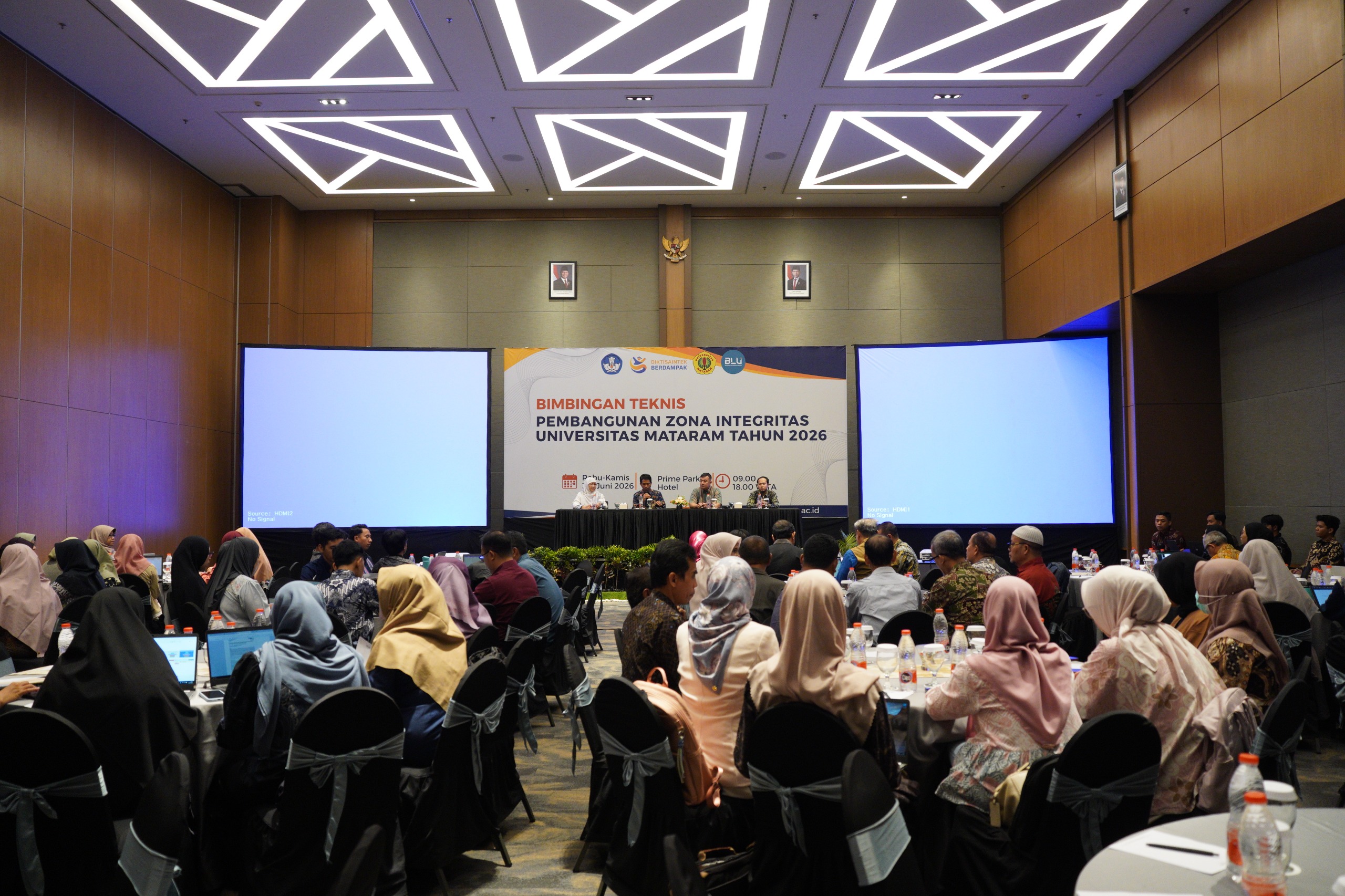
Mataram, University of Mataram — The University of Mataram (Unram) held a Technical Guidance Program (Bimtek) on Integrity Zone (ZI) Development on Wednesday, June 3, 2026, at Prime Park Hotel, Mataram. The event was attended by university leaders and Integrity Zone managers from across the university.
The program was organized as part of the university’s efforts to strengthen the commitment of all work units to establishing a higher education governance system that is clean, accountable, and focused on delivering high-quality public services.
In his opening remarks and keynote address, the Rector of the University of Mataram, Prof. Dr. Sukardi, M.Pd., emphasized the importance of Integrity Zone development as an integral part of institutional governance transformation. According to him, building an Integrity Zone is not merely an administrative requirement but a strategic initiative to foster a professional, transparent, and integrity-driven work culture throughout the university.
“We aim to build a system that provides the best possible services to the public while strengthening accountability and public trust in the University of Mataram,” said Prof. Sukardi.
The event featured two keynote speakers, Syachrudin and Muhamad Armansyah, who delivered presentations on strategies and best practices for implementing Integrity Zone development toward achieving the status of a Corruption-Free Area (WBK) and a Clean and Service-Oriented Bureaucratic Area (WBBM).
The materials presented covered various aspects of Integrity Zone development, including change management, business process improvement, human resource management reform, strengthened supervision mechanisms, and enhancements in public service quality.
In his presentation, Syachrudin explained that Integrity Zone development is driven by the need to create a governance system that is clean, accountable, and free from corruption, while also eliminating inefficient bureaucratic practices through improved service quality.
He also outlined several key indicators of successful Integrity Zone implementation, including greater service transparency, reduced levels of misconduct, improved public service quality, and increased compliance with applicable regulations.
Through this program, all work units within the University of Mataram are expected to become better prepared to consistently implement the principles of the Integrity Zone, thereby supporting the realization of a university governance system that is excellent, professional, and built upon integrity.