
BULD DPD RI and Unram Synergize: Building Sustainable Spatial Policy
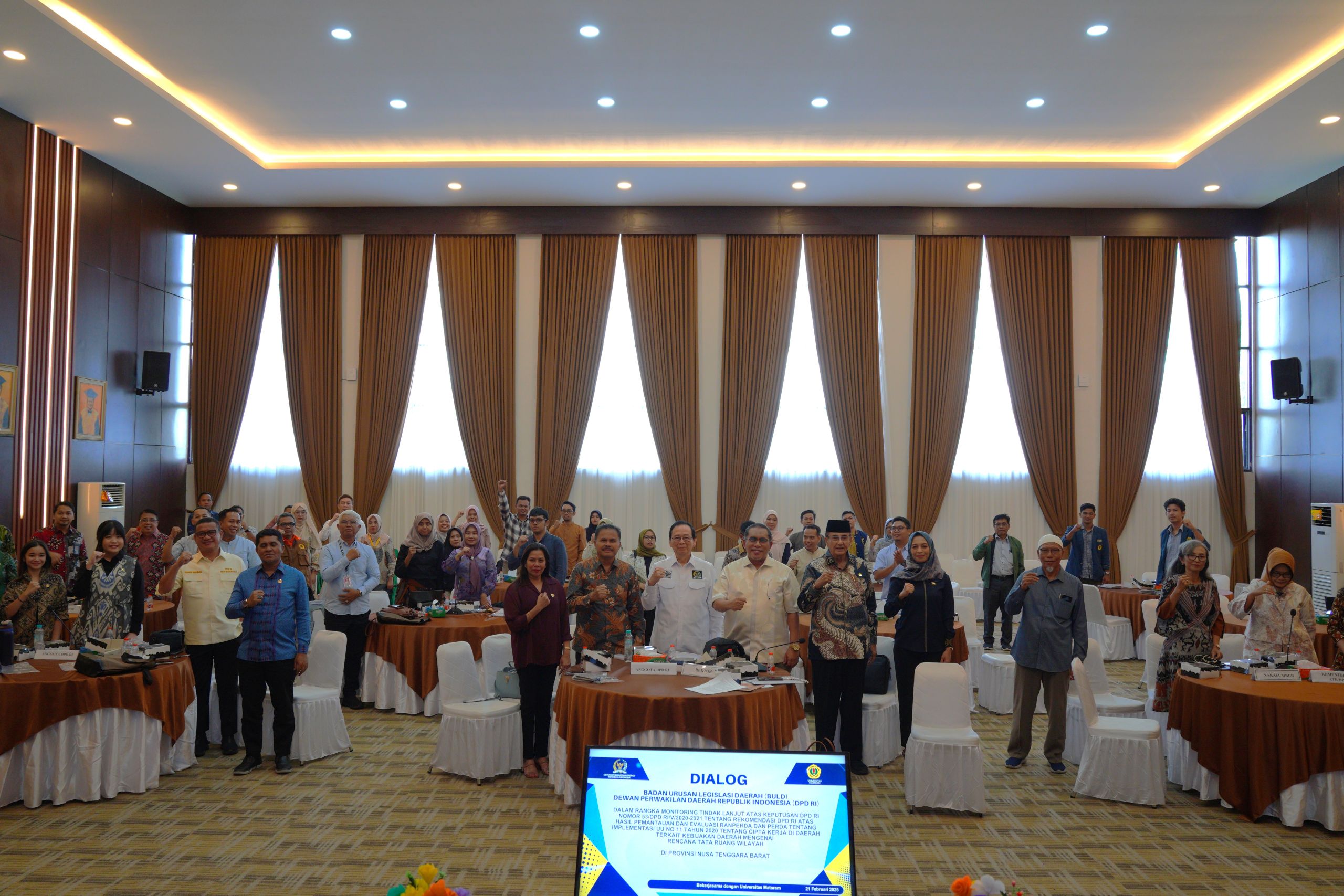
Mataram, University of Mataram – On Friday, February 21, 2025, the University of Mataram (Unram) in collaboration with the Regional Legislation Agency (BULD) and the Regional Representative Council of the Republic of Indonesia (DPD RI) held a dialogue in order to monitor follow-up on the results of monitoring and evaluation of draft regional regulations and regional regulations related to the implementation of Law Number 11 of 2020 concerning Job Creation. This dialog focuses on regional policies regarding regional spatial plans and takes place in the Senate Conference Room, Unram Rectorate.
The event was attended by the Head of BULD DPD RI, the Rector of Unram, Chairman of Commission IV of the NTB Provincial DPRD, representatives of the NTB Provincial Public Works and Spatial Planning Office, Vice Chancellor, Head of Bureau, Dean, Head of Institution, Director of Postgraduate Unram, Director of Unram Hospital, speakers, moderators, and other invited guests.
Vice Rector I for Academic Affairs, Prof. Dr. Sitti Hilyana, in her speech conveyed the importance of synergy in advancing human resources as part of the university’s success. She highlighted the challenges of spatial management in NTB which consists of multiple islands and how this requires special attention in spatial planning, especially in the preparation of the 2044 Provincial Spatial Plan (RTRWP).
“We have the same responsibility to advance human resources as one of the ideals of all universities. With the large number of islands in NTB, our spatial planning has its own challenges and must be adapted to unique geographical conditions,” she said.
The Head of BULD DPD RI, Dr. Drs. Marthin Billa, M.M., in his introductory discussion emphasized the role of DPD RI in monitoring and evaluating the draft regional regulations and the regional regulations itself.
“DPD RI is tasked with bridging regional interests and encouraging regulatory harmonization between the central and regional levels. Harmonization of central and regional legislation must be strengthened so that the regulated policies do not overlap, “he explained.
He highlighted the challenges in adjusting the RTRW with national policies, including regulatory discrepancies and the lack of socialization to local governments which resulted in a lack of understanding and readiness in implementing changes in spatial policies.
As part of the event, a group photo session was held and souvenirs handed over as a symbol of appreciation for the cooperation that has been established.
The main event of the discussion in this activity presented three speakers, including Prof. Dr. Arba, S.H., H.Hum. (Expert on Regional Spatial Law); Prof. Dr. Sitti Hilyana, (Expert on Regional Development / Regional Spatial Planning); and Ni Nyoman Yuli Suryani, S.T., M.T. (Head of Spatial Planning of the NTB Public Works and Public Housing Agency). The discussion was guided by moderator Dr. Andi Chairil Ichsan, S.Hut., M.Si.
In addition, the discussion and question and answer session also presented the Director of Regional Spatial Planning Development Region II of the Ministry of Agrarian Affairs and Spatial Planning / National Land Agency (ATR / BPN), Chriesty Elisabeth Lengkong, S.Si., M.Si., MEEM, as a respondent.
In the conclusion session delivered by Mirah Midadan Fahmid, revealed that there are still inconsistencies in spatial planning, both in land and sea areas.
“The implementation of the Job Creation Law through Government Regulation Number 21 of 2021 is considered sufficient to integrate spatial planning, but still faces technical obstacles, including cross-sectoral coordination. Another problem identified is the Risk-Based Approach (RBA)-based Online Single Submission (OSS) system that still needs improvement so that it does not only focus on investment, but also pays attention to aspects of licenses that have been issued,” he added.
Furthermore, there is an inconsistency between the Job Creation Law and the Spatial Planning Law, where the Spatial Planning Law is more oriented towards the interests of the community, while the Job Creation Law is oriented towards facilitating investment. This difference in orientation is a challenge in implementing regulations in the field. Current breakthroughs include the integration of land, sea, air spatial planning, and a comprehensive spatial planning model.
The results of this dialogue will be further formulated as material to be presented in a joint meeting with the MPR, DPR, and relevant ministries, such as the Ministry of Home Affairs, Ministry of National Development Planning/Bappenas, and Ministry of Maritime Affairs and Fisheries on February 26, 2025.
With this dialog, it is hoped that the synergy between the central government, regions, academics, and other stakeholders can be further strengthened. The results of the discussion will become an important foundation in formulating spatial policies that are more inclusive, sustainable, and oriented towards community welfare and regional economic growth. Joint commitment in following up the results of this dialog is expected to provide real solutions to future spatial challenges.