
Unram Collaborates with Konservasi Indonesia and Kaliuda Village-Owned Enterprise to Restore Hope for Farmers in East Sumba
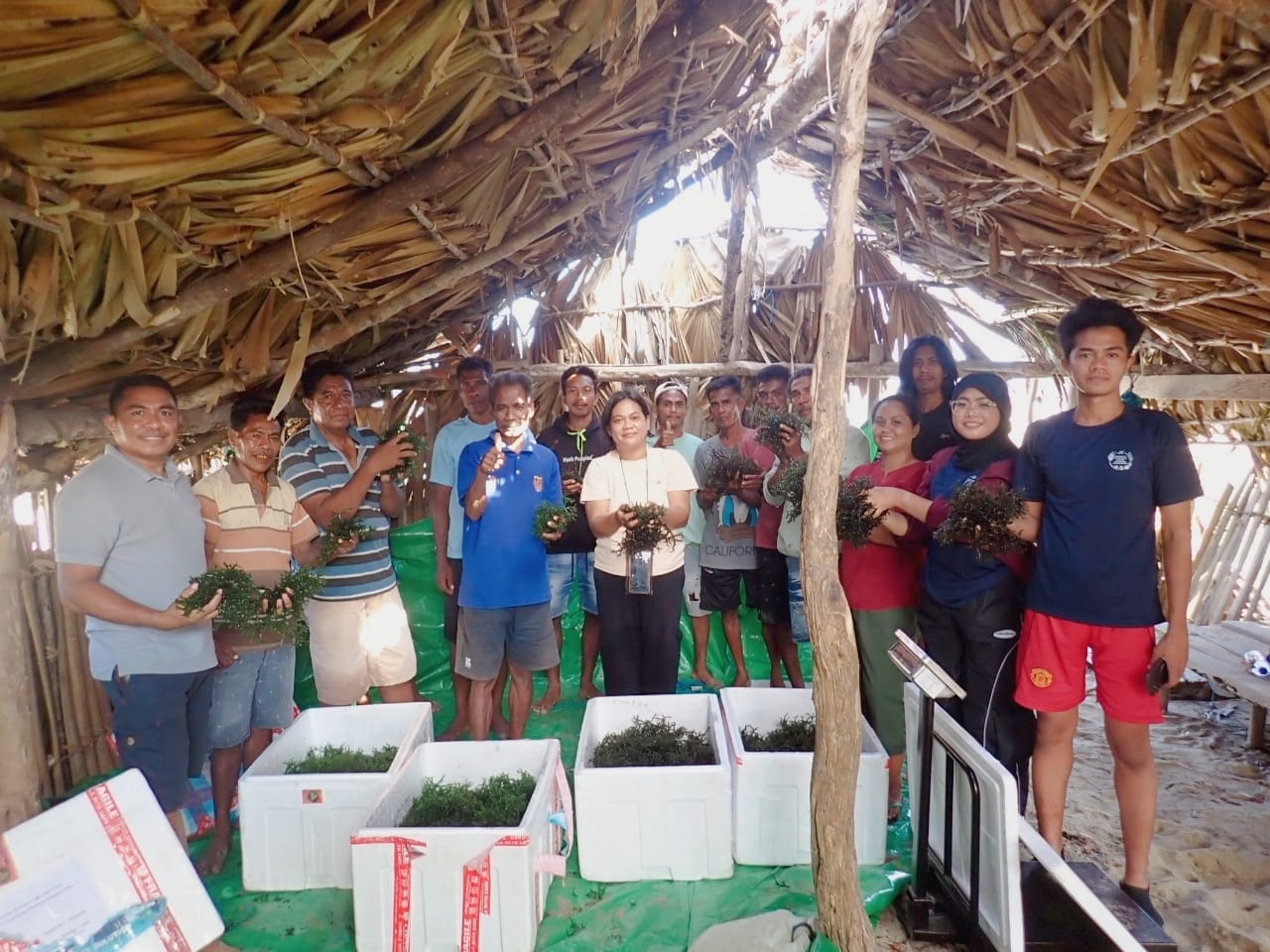
Mataram, University of Mataram — After more than 15 years of declining seed quality and productivity due to repeated use, seaweed farmers in Kaliuda Village, East Sumba Regency, are entering a new chapter in sustainable seaweed cultivation. Through a collaboration between the University of Mataram (Unram), Konservasi Indonesia (KI), Manandang Kaliuda Village-Owned Enterprise (BUMDes), and the East Sumba Fisheries Office, the community successfully harvested six tons of superior seaweed seedlings, a milestone that marks both the revival of the coastal economy and a shift toward more sustainable farming practices.
This initiative began in early 2025, when Konservasi Indonesia, in partnership with Unram and BUMDes Kaliuda, established a pilot cultivation site in Lendunga. A total of 80 kilograms of superior seaweed seedlings were brought from Lombok by Unram’s research team, led by Dr. Eka S. Prasedya, who also serves as the principal investigator of the GlobalSeaweed-PROTECT project supported by UK Research and Innovation (UKRI). From this initial stock, the farmers have now produced 1.8 tons of healthy seedlings across four strains, Kappaphycus striatus (Sacol), Kappaphycus striatus (Payaka), Cottoni Lokal, and SP1, which is currently undergoing identification.
Dr. Eka explained that the team’s support extended beyond seed distribution, encompassing biosecurity training and the development of a sustainable seed cultivation system to help farmers become more self-reliant while maintaining the genetic quality of their seaweed. “We want the community to understand the science behind cultivation, so that productivity can increase without harming the environment,” he said.
According to Fitri Hasibuan, Vice President of Programs at Konservasi Indonesia, the success in Kaliuda demonstrates the power of collaborative action. Through the support of the Global Fund for Coral Reefs (GFCR) under the TeKSI program, the implemented nursery model not only improved yields but also contributed to the protection of coral reef ecosystems in East Sumba. “Through our collaboration with Unram, we are able to produce stable seedlings throughout the year while preserving the health of coastal ecosystems,” she explained.
The Head of the East Sumba Fisheries Office, Markus Windi, expressed his appreciation for the cross-institutional collaboration.
“BUMDes Manandang has demonstrated that seed cultivation can serve not only as a pillar of the village economy but also as a means to preserve marine sustainability,” he said.
Meanwhile, Chairperson of BUMDes Manandang, Christiani Valentine Salean, shared her optimism about the community’s progress.
“In the past, we struggled to obtain quality seedlings. Now, from our six-ton harvest, we are even able to sell part of it. This is a significant step toward self-sufficiency,” she noted.